Concrete scanning with ground penetrating radar is a non-destructive survey that locates reinforcement, conduits and embedded items in a slab before drilling, sawing or coring. An antenna emits electromagnetic waves and records their reflections, which makes it possible to estimate the position and depth of obstacles.
On a job site, a single badly placed opening can sever a rebar, pierce a live electrical conduit or weaken a slab. Ground penetrating radar exists precisely to avoid those unpleasant surprises. This guide explains the principle behind the method, what it actually detects and how a survey unfolds, so that it is clear when and why to order one.
What concrete scanning with GPR is
Ground penetrating radar, often shortened to GPR, is a subsurface imaging technology adapted to concrete. An antenna sweeps the surface of the slab and records the reflections of electromagnetic waves at the interfaces between materials. Each contrast, between concrete and steel for example, returns a signal that the technician interprets.
The depth of an element is calculated from the return time of the signal and the speed of the waves in concrete. This principle is framed by the ASTM D6432 guide on using ground penetrating radar, which describes the equipment, field procedures and data interpretation.
A non-destructive and safe method
Unlike industrial radiography, ground penetrating radar emits low-power radio waves and uses no ionizing radiation. There is therefore no perimeter to evacuate and no risk to occupants. The method works from a single face of the slab, which makes it particularly flexible in buildings that remain in operation.
What GPR detects in concrete
A well-conducted survey locates most of the elements that cause trouble when drilling. It nonetheless remains important to know its strengths and limits, because no assessment method is infallible. The summary below sets out what the technology detects and the nuances to keep in mind.
The main strength of the method remains locating the steel mat. To go further on this point, the resource on rebar detection in concrete details the cases where steel reads clearly and those that call for extra caution.
One safety principle is worth remembering: an area with no detected indication never proves that it is entirely free of obstacles. Depths remain estimates, and the technician’s judgment remains essential to clear any doubt before the slab is opened.
- Rebar and cables: yes, path and estimated depth; a dense mat hides the elements below
- Metal conduits: yes; the exact type cannot always be identified
- Non-metallic conduits: variable; depends on diameter and contrast
- Slab underside and voids: yes if the interface is readable; useful before a heavy anchor
- Very fine cracks: limited; no reliable detection guaranteed
How a typical survey unfolds
A quality survey follows a clear sequence, from the office to the marks on the floor. Understanding these steps helps prepare the scope of work and obtain a deliverable that is genuinely useful.
The four steps of the survey
The quality of the result depends heavily on preparation. A clear, clean and accessible surface speeds up data acquisition and reduces blind spots. The guide on properly preparing the site sets out the ideal conditions to bring together before the crew arrives.
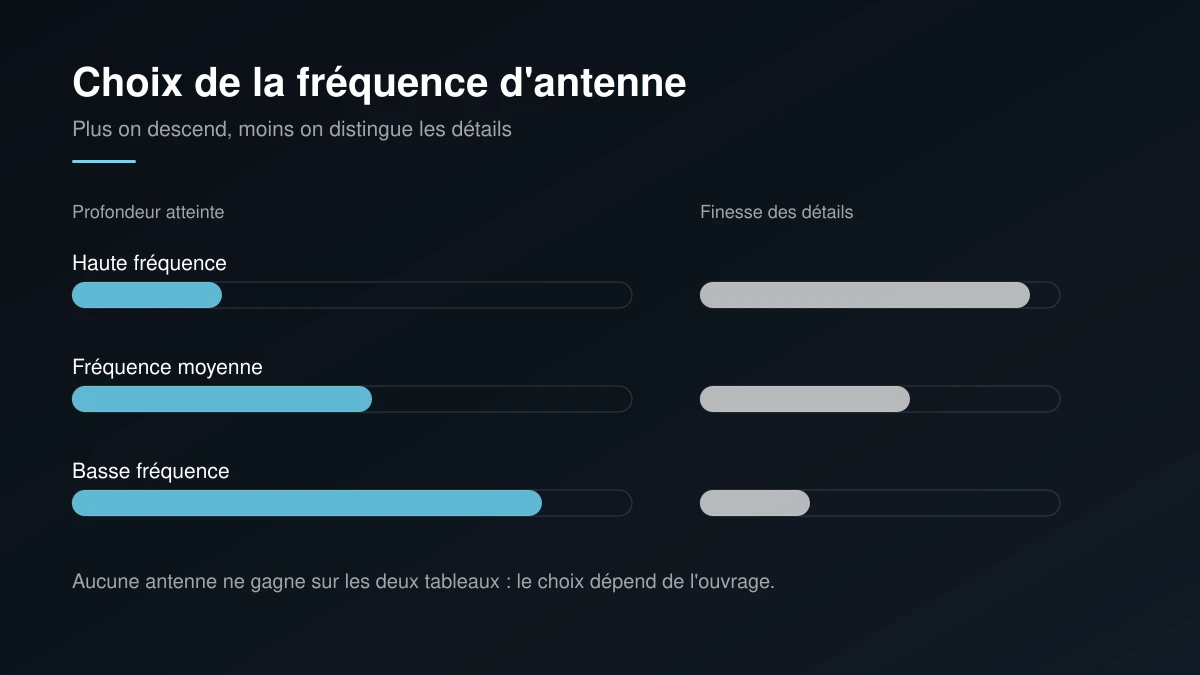
Technical choices matter too. High frequency antennas offer better resolution near the surface, while low frequencies penetrate deeper with less precision. This trade-off is well explained in the resource on choosing the antenna frequency, a decisive factor depending on slab thickness.
Planning a hole or an opening in an existing slab? Request a GPR survey before work begins to secure the operation and protect the schedule.
- Scoping: define the planned openings, the relevant areas and the expected deliverable.
- Acquisition: sweep the surface in parallel passes to cover the area.
- Interpretation: read the profiles to estimate positions and depths.
- Reporting: deliver the results as markings, photos, sketches or a report.
When and why to order a scan
The right reflex is to order the survey as soon as work reaches inside the slab. Several situations fully justify it.
The logic of scanning before core drilling is simple: a severed rebar weakens the structure, and a damaged cable leads to costs and risks far greater than the price of the survey. A non-destructive GPR survey therefore fits naturally into planning, as a preventive measure rather than an expense.
This approach is in line with sound engineering practice. Ground penetrating radar is among the non-destructive testing methods reviewed by ACI for evaluating the condition of in-place concrete and its reinforcement, alongside other complementary techniques depending on the needs of the project.
- Before core drilling for plumbing, ventilation or electrical work.
- Before sawing a new opening in a floor or a wall.
- Before anchoring heavy equipment to a structural slab.
- Before drilling a post-tensioned slab, where a mistake can be critical.
- To document a structure whose drawings are no longer up to date.
Conclusion
Concrete scanning with GPR is now a basic reflex for any responsible drilling, sawing or coring work. It reveals rebar, conduits and voids before the opening, protects the structure and keeps crews safe, with no radiation and no damage. Well prepared and well interpreted, it turns an unknown into reliable data for making decisions with confidence. To avoid unpleasant surprises, plan the survey from the design phase and entrust its interpretation to a properly equipped team. Request a quote suited to the scope of your project.