In a post-tensioned slab, a severed cable cannot be patched the way a cut rebar can. Locating post-tension cables before drilling is therefore a safety step, not paperwork. These cables are steel strands held under heavy tension by anchorages at the slab edges. Cutting into one releases that energy at once, which endangers anyone nearby and removes load capacity from the structure.
A survey carried out before the opening locates the cables, the reinforcement and the embedded conduits, then marks them directly on the surface. The useful question is not whether the slab contains cables, but exactly where they run at the intended point. That distinction changes how a project gets planned.
Why a post-tensioned slab leaves no room for guesswork
Passive reinforcement only works once the concrete deforms. A post-tension strand, by contrast, is tensioned from the moment the structure enters service and keeps the concrete in permanent compression. That precompression allows longer spans and thinner slabs, which explains why it appears so often in parking structures, office floors and certain bridges.
The trade-off is simple to state: the stored energy has to stay contained. Cutting a strand causes a sudden release, sometimes with material ejected at the anchorage. Beyond the immediate hazard, the affected area loses the compression that held it together, and repair generally calls for a full structural intervention rather than patching.
There is a less visible consequence as well. A prestressed slab distributes its forces across an entire bay, so local damage rarely stays local. The notions used here are set out on the post-tension, prestressing strands and ducts page. Judging the effect usually calls for a structural assessment before the area returns to service.
The draped profile, and why a drawing is not enough
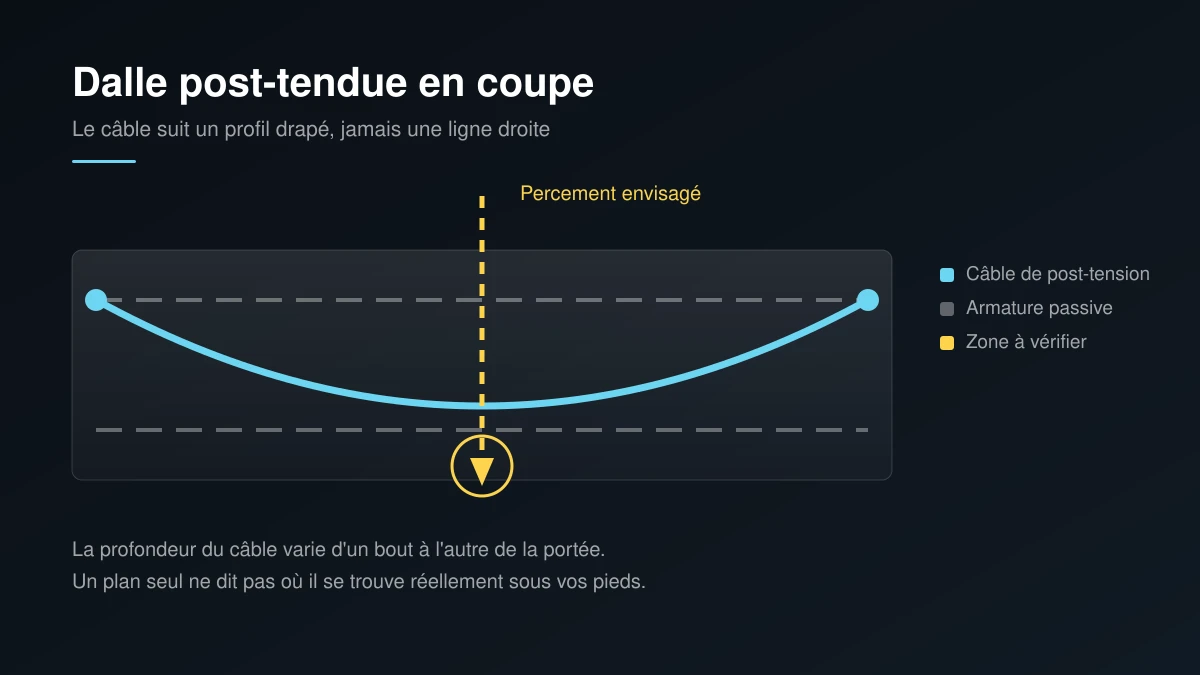
A post-tension cable does not cross a slab in a straight line. It follows a draped profile, high near the supports and low at midspan, so that it counters bending forces where they matter most. Its depth therefore changes continuously along the bay. Two holes a few steps apart can sit one safely above the cable and the other directly on it.
Shop drawings record design intent. They do not capture adjustments made while tying reinforcement, ducts shifted to clear a blockout, or changes made during the life of the building. In most cases the difference stays small, yet small is enough to turn a hole believed to be safe into an incident.
Ground penetrating radar reads the slab as it stands today. Where doubt remains, a second pass from the opposite face or a change of antenna helps resolve the ambiguity. The terms used in survey reports are explained in the technical glossary.
What a survey can separate below the surface
A careful sweep does not hunt for strands alone. It builds a picture of everything occupying the slab thickness, which avoids dodging a cable only to hit a conduit instead.
- Post-tension strands and their ducts, recognisable by their curved profile
- Passive reinforcement, more regular and usually closer to the surface
- Electrical conduits and plumbing cast into the concrete
- Voids, honeycombing and delaminated zones
When locating cables becomes unavoidable
The need appears as soon as an operation cuts into the material: core drilling for a plumbing run, sawing an opening, setting a chemical or mechanical anchor, or underpinning work. It applies to shallow holes too, because a short anchor can reach a strand that rises close to the surface near the supports.
Timing matters as much as the principle. A survey ordered once the trades are already mobilised often stops the site. Ordered during planning, it feeds the shop drawings and allows an opening to shift by a few centimetres while everything can still move. If a project is approaching that stage, reviewing concrete scanning and the pricing page helps frame the scope before the visit.
Limits worth knowing before ordering a survey
No non-destructive method sees everything. A dense reinforcement mat acts as a screen and hides whatever lies beneath it. A very uneven surface degrades antenna contact. Heavily saturated concrete or a metal deck changes how the signal travels and cuts the usable depth.
These constraints do not disqualify the method, they shape how it gets used. They sometimes justify combining several frequencies, cross-checking with corrosion mapping when the condition of the steel is also in question, or recommending an inspection core at a point judged safe. An honest report states what was seen, and equally what the survey could not establish.
Conclusion
Locating post-tension cables turns a dangerous unknown into usable information. It protects the people on site, preserves the capacity of the structure and avoids repairs far costlier than the survey itself. General background on the technique is available on the prestressed concrete reference page.
To have cables located before opening a slab, describe the project and the target area on the contact page. The earlier the need is stated, the more easily the survey fits the schedule.