Concrete sawing without prior locating exposes the crew and the structure to major hazards: cut rebar, a live electrical conduit or a severed post-tension cable. A GPR scan of the slab locates these embedded elements before the first cut, which protects workers, the schedule and the integrity of the structure.
On a job site, the pressure is constant: meet the schedule, deliver a clean cut, keep the crew safe. Yet a single decision made too quickly can derail everything. Running a blade into a slab without knowing what it contains means gambling with worker safety and the soundness of the structure. The good news is that this uncertainty can be resolved upfront, through an accurate reading of the concrete before the first spark.
Why blind concrete sawing is a risky bet
A slab is never a homogeneous block. It conceals a network of steel, conduits and sometimes tensioned cables whose actual layout often differs from the original drawings. Successive renovations, undocumented additions and conduits shifted during the pour leave paper records incomplete.
Cutting without seeing this network means accepting that the blade may sever a vital element. The consequences go well beyond a simple setback: a site shutdown, an investigation, structural repair or serious injury. Technical bodies also recommend assessing a structure before any destructive work, as the non-destructive testing methods for concrete documented by the American Concrete Institute point out.
Prior locating turns this gamble into a controlled decision. Rather than hoping the area is clear, the crew knows exactly where to place its cut.
The three hidden hazards under the slab
Three embedded elements account for most serious incidents during a cut. Each one deserves particular attention, because their presence cannot be guessed with the naked eye.
Cut rebar and loss of load-bearing capacity
Steel reinforcement gives concrete its tensile strength. Severing a bar in the wrong place weakens the slab locally and can compromise its ability to carry the loads it was designed for.
On a structural slab or a multi-level parking garage floor, a few cut bars are enough to create a weak point. Rebar detection in concrete makes it possible to lay out an opening that avoids critical zones and preserves the integrity of the structure.
Live electrical conduit
A live conduit that meets a blade causes a short circuit, an electric arc and a direct risk of electric shock for the operator. This hazard is taken very seriously in Quebec: the electrical hazard recognized by the CNESST is subject to strict hazardous energy control measures.
Locating conduits before cutting means avoiding an accident that can be fatal and that remains, in the vast majority of cases, entirely preventable.
Severed post-tension cable
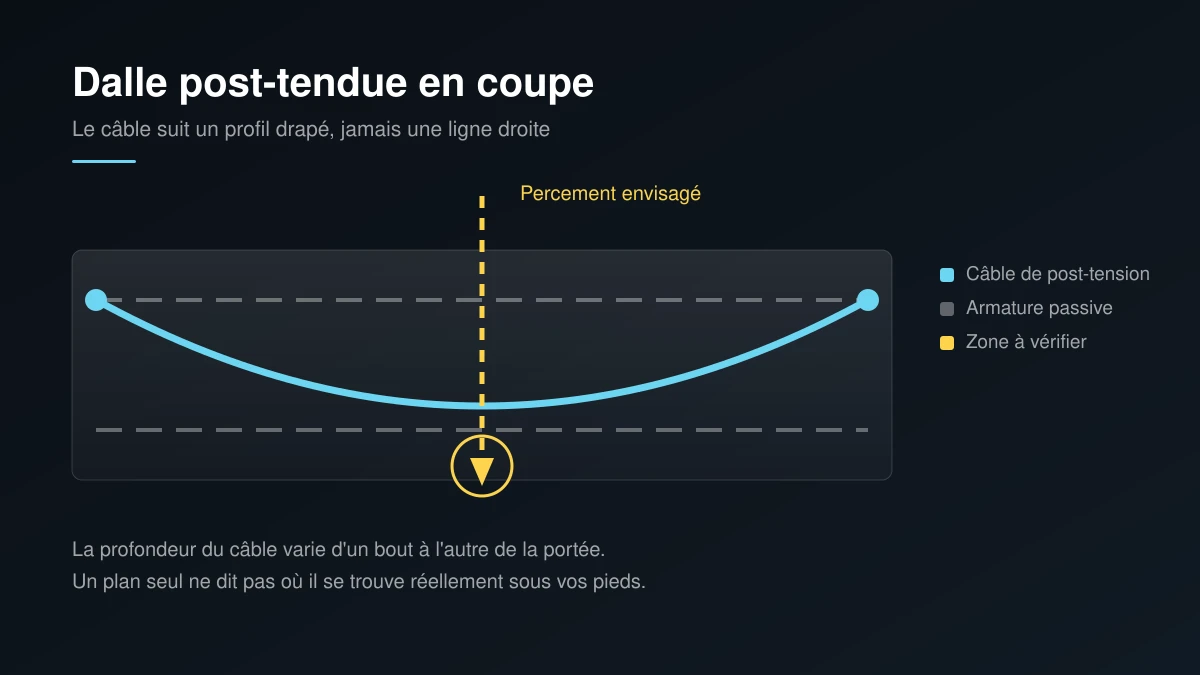
The post-tension cable is the most insidious of the three. Always under heavy permanent tension, it releases its energy abruptly if struck, with an extremely dangerous whiplash effect for every worker nearby.
On a post-tensioned slab, a single mistake can therefore be catastrophic. Locating post-tension cables before any cut is not an optional precaution, it is a basic safety requirement.
How a GPR scan protects before the first cut
Ground penetrating radar, or GPR, sends electromagnetic pulses into the concrete and records the reflections returned by the interfaces between materials. A rebar then appears as a hyperbola on the profile, which makes it possible to trace its position.
What GPR actually detects
The sweep locates the path and estimated depth of rebar and cables, picks up metallic and non-metallic conduits depending on their diameter, and flags voids or the slab underside when the interface is readable. The method is framed by a reference guide on the ground penetrating radar method published by ASTM.
It pays to stay clear-eyed about the limits: dense reinforcement, a metal surface or very wet concrete can reduce readability, and depths remain estimates. That is why interpretation by an experienced technician makes all the difference.
A fast, non-destructive sweep
The great advantage of GPR is that it leaves no trace. No exploratory core, no needless hole: the antenna simply sweeps the surface and the technician marks the slab directly.
This visual marking gives the crew a concrete map of the area. The blade then enters the concrete where the path is clear, with no guesswork.
Before laying out the next opening, have what lies hidden in the slab confirmed by a technician qualified in GPR. A GPR concrete scanning service confirms the position of rebar and conduits before the blade enters the concrete.
What locating really protects
Scanning before cutting protects three assets that every project manager watches closely. The comparison below sums up the difference between the two approaches.
- Crew safety: risk of electric shock and whiplash, versus a validated and marked cutting zone
- Schedule: unplanned shutdowns, investigations and rework, versus a planned cut with no surprises
- Structure: rebar or cable potentially cut, versus critical elements bypassed
- Costs: repairs and lost hours, versus a short, targeted check
The concrete benefits can be summed up as follows:
- A crew that works without exposure to a live conduit or a tensioned cable.
- A schedule that holds, because costly surprises are ruled out upfront.
- A structure whose load-bearing capacity remains intact after the opening.
This logic applies to large projects and small renovations alike. A prior sweep supports general contractors in planning reliable, documented cuts.
Preparing the cut properly after the scan
Good locating starts even before the technician arrives. Clearing the surface, removing floor coverings and providing access to the area speed up the work and improve data quality.
To get the most out of the sweep, a few habits help:
- Gather the available drawings to cross-check them against the scan results.
- Clean and clear the area to be surveyed for optimal antenna contact.
- Clearly identify the planned openings to target the locating work.
Properly preparing the site before the sweep yields clean markings and lets the cut follow without delay. Once the slab has been read and annotated, the sawing crew works with a confidence that no visual inspection can offer.
Conclusion
Concrete sawing is anything but routine once a blade approaches rebar, a live conduit or a post-tension cable. A prior GPR scan turns a risk into a controlled operation: it protects the crew, keeps the schedule on track and preserves the structure. Plan a sweep of the slab before every cut and give your crew a head start on the unexpected.